From Cockpit to Command: How Raft and Boeing Are Connecting the Apache to the Modern Battlefield
Raft and Boeing demonstrated how open architectures and an agnostic data layer can connect the latest evolution of the AH-64E Apache to the broader battlefield data ecosystem without rebuilding underlying infrastructure.
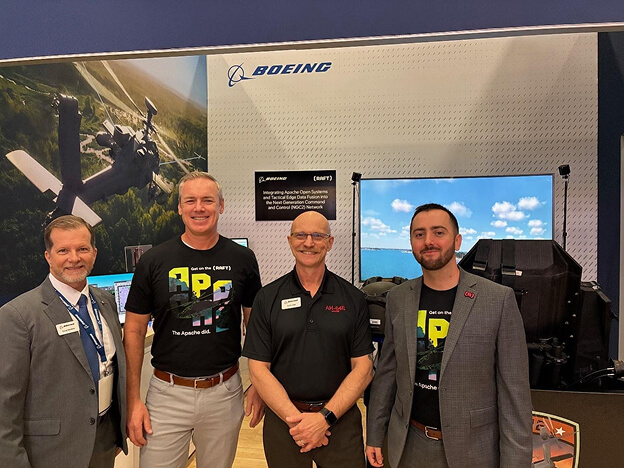
Raft and Boeing demonstrate how seamless data sharing could allow today’s E-model Apache to plug into the Army’s future command and control network.
Across the battlespace, aircraft, ground forces, sensors, and command systems are generating enormous amounts of mission-critical data. But too often, that data remains trapped in disconnected systems, limiting how quickly warfighters can use it to understand what’s happening, make decisions, and act.
For the U.S. Army, modernization isn’t simply about introducing new technology. It’s about ensuring that existing and emerging capabilities work together as one connected force.
That’s exactly what Raft and Boeing demonstrated at the 2026 Association of the United States Army (AUSA) Annual Meeting & Exposition.
By integrating Raft Data Platform ([R]DP) with Boeing’s AH-64E Version 6.5 (v6.5) Apache attack helicopter through its current Open Systems Interface (OSI), the companies demonstrated how an open, modular architecture can connect one of the Army’s most capable aviation platforms to the broader battlefield data ecosystem now – without requiring a fundamental redesign of the underlying data environment.
Turning Today’s Apache into an Active Node on the Battlefield
Traditionally, battlefield data moves through a complex network of systems before reaching the platforms and operators who need it. The challenge isn’t just getting data to the aircraft. It’s ensuring the aircraft can contribute valuable data back to the rest of the force.
The Raft and Boeing integration demonstrates how that bidirectional data exchange can be realized on the AH-64E v6.5 today.
Using [R]DP as an agnostic data layer, external mission data flows into the Apache’s mission environment, integrating data from across the battlespace into the Apache’s common operating picture and mission systems.
But the Apache isn’t simply consuming that data.
Through the same integration, the aircraft can publish its own position, location, and information (PLI), along with target nominations from its existing sensors, back through [R]DP to the broader battlefield data ecosystem including systems supporting the Army’s Next Generation Command and Control (NGC2) modernization efforts.
The result is a connected mission platform that both consumes and contributes battlefield intelligence without any new hardware or architecture requirements.
What Does That Look Like in Practice?
Consider a mission in which an Apache crew needs to understand evolving battlefield conditions, identify a potential target, and share that information with other elements of the force.
With the Raft and Boeing integration:
- Mission data reaches the cockpit. [R]DP delivers external battlefield information into the Apache’s mission systems, contributing to a integrated mission picture.
- The crew acts on that information. Using the integrated mission picture, the Apache crew can identify and select a potential target.
- The Apache contributes back to the force. Target nominations and aircraft position information are published through [R]DP, making them available to connected systems across the broader battlefield ecosystem.
This is what a more connected battlefield can look like: information moving between platforms and command systems, enabling warfighters to make better-informed decisions without being constrained by disconnected technology.
Open Architecture Is an Operational Advantage.
For years, the defense industry has talked about the importance of the Modular Open Systems Approach (MOSA).
The principle is straightforward: military systems should be designed so capabilities can be integrated, upgraded, and replaced without requiring an entirely new architecture every time technology evolves.
But the real value of MOSA is the freedom to introduce new capabilities as threats evolve, integrate technologies from different vendors, and modernize existing platforms without becoming dependent on a single proprietary ecosystem.
Raft and Boeing’s demonstration put those principles into practice.
Boeing’s open mission systems architecture provides a rapid integration pathway into today’s Apache that’s ready for v6.5 fielding. Raft’s agnostic data layer connects the aircraft to mission data across the broader battlefield ecosystem.
Together, they demonstrate how complementary, best-of-breed technologies can work together without forcing the Army to choose between preserving existing investments and adopting new capabilities.
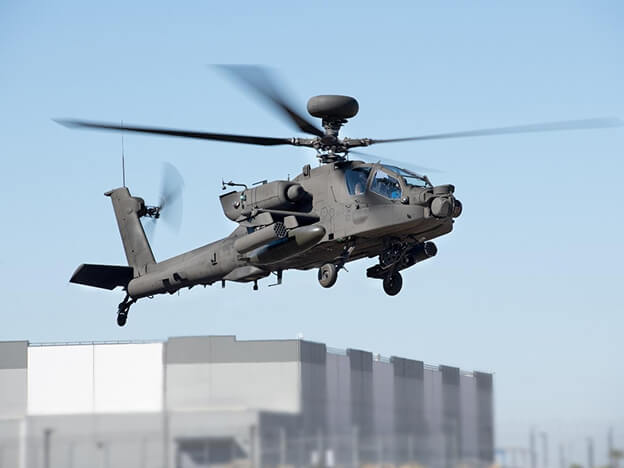
The AH-64E Apache Version 6.5 is the latest evolution of the world’s most dominant attack helicopter capable of integrating new capabilities through an open systems approach.
Learn more about Raft Data Platform ([R]DP) and how Raft is enabling interoperability across the modern battlefield.